Hi to all my family, friends and colleagues,
Wendy and I are about to embark on our Great Tour of China, driving approximately 11,000 kms through China and Tibet. Making up the crew will be Chris Cooper, who has driven extensively through Africa and South America. The Tour starts from the Great Wall, just outside Beijing, on April 28th. After four weeks of driving across central China and into Tibet to the base camp at Mount Everest, we then head back through south-western China to arrive in Hong Kong on the 28th May. The Tour is organised by the Historic Endurance Rally Organisation(HERO).
We are driving in the Toyota Landcruiser we took round South America a couple of years ago. This time we have added an extra fuel tank to give us a range of 1,000kms without re-fuelling, navigation equipment, security cage for all our spares and equipment and a second spare wheel.
We are raising money for Hope and Homes for Children. This charity is based in Wiltshire and supports thousands of abandoned children in 14 countries around the world. If you would like to learn more about their work you can look them up on the web at: http://www.hopeandhomes.org
Once the Tour has started I will be posting regular updates on this site. I hope you enjoy reading about our adventure to one of the most fascinating countries in the world.

February 28th - Heritage Motor Centre, Gaydon
We drove up to the Heritage Motor Centre in Gaydon, Warwickshire, for the final pre-event briefing.
We met two Inca Trail participants, Alan Crisp and Terence English. Also, there were those who were doing their first HERO event, Jim Clarke, Kit Constable and Nick Barker, Simon Dedman and Eric Archer, Norman and Hazel Leighton , Ian Perkins and Roger and Sue Shuttleworth.
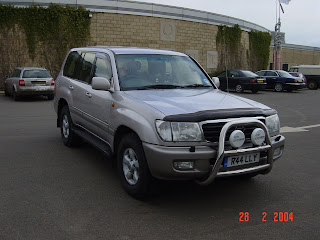
The car parked at the Centre.
We met two Inca Trail participants, Alan Crisp and Terence English. Also, there were those who were doing their first HERO event, Jim Clarke, Kit Constable and Nick Barker, Simon Dedman and Eric Archer, Norman and Hazel Leighton , Ian Perkins and Roger and Sue Shuttleworth.
The car parked at the Centre.

March 3rd - Delivery to Tilbury
My co-driver, Chris Cooper, drove the Landcruiser from the garage in Littlehampton, where it has been prepared for the Great Tour of China, to the container depot near Tilbury.

I drove across to Tilbury from my home in South London and met Chris at the depot. Also there, was Richard Smith with his Landcruiser. Both cars were put into one 40 feet container. Richard's car was loaded first.


Like 'two peas in a pod'!

The cars were being shipped by container ship to a port in China about 100 miles from Beijing. Once unloaded from the ship, the container would be trucked to a depot in Beijing.
The next time we would see the cars would be when we collected them in Beijing, just before the start of the Great Tour of China, at the end of April.

I drove across to Tilbury from my home in South London and met Chris at the depot. Also there, was Richard Smith with his Landcruiser. Both cars were put into one 40 feet container. Richard's car was loaded first.

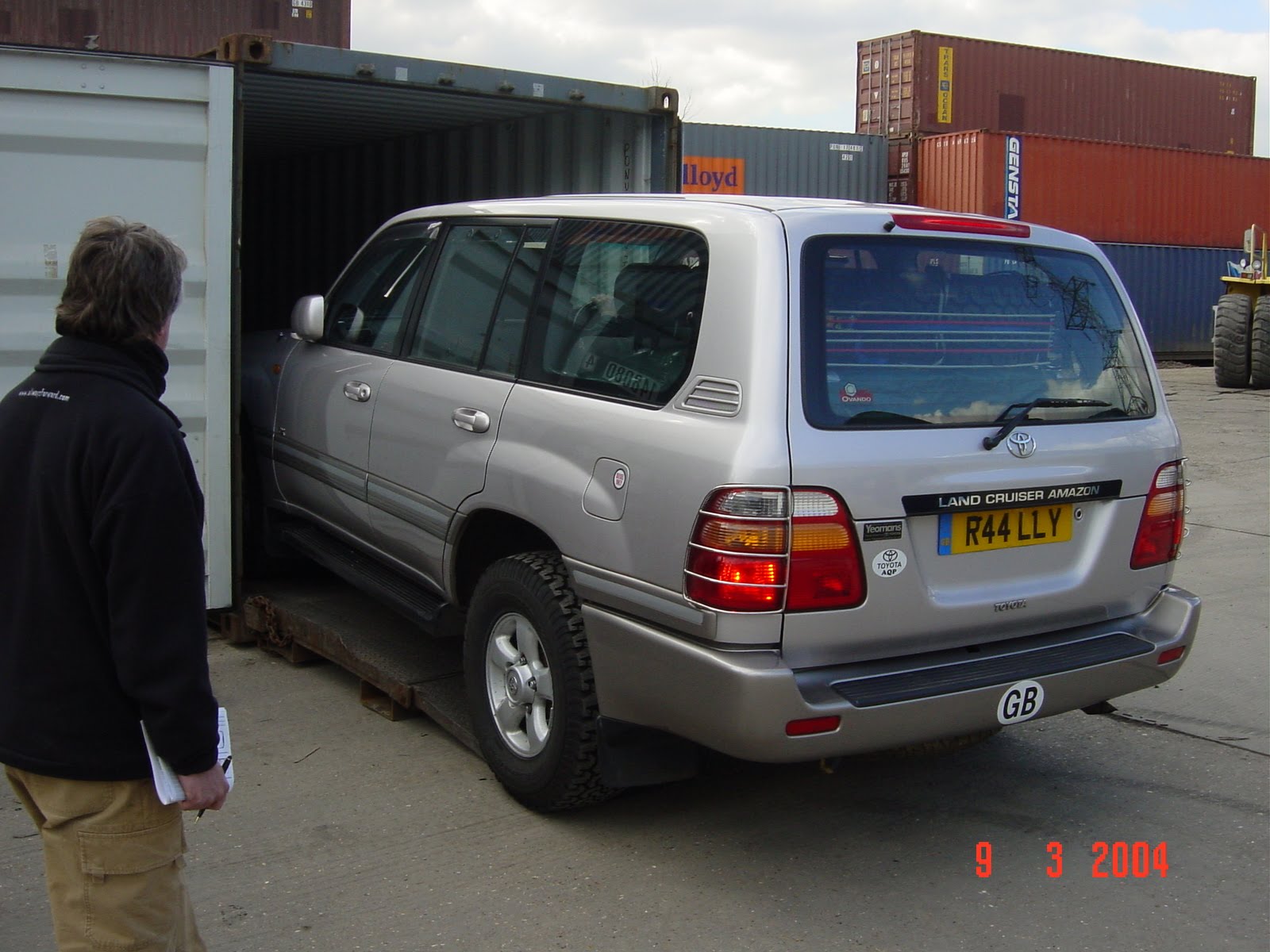
Like 'two peas in a pod'!

The cars were being shipped by container ship to a port in China about 100 miles from Beijing. Once unloaded from the ship, the container would be trucked to a depot in Beijing.
The next time we would see the cars would be when we collected them in Beijing, just before the start of the Great Tour of China, at the end of April.
April 15th - Latest News
The container ship delivering the cars coming from the UK and Europe has left its last port of call before arriving tomorrow at the port of Xingang. Xingang is about 100 miles from Beijing and the containers will be transported overland to Beijing for us to collect on Tuesday 27th April
April 20th - Latest News
Good news, all the cars from Europe have arrived in Beijing. The cars will be unloaded and cleared through customs, ready for us to collect them in a week's time. Under Chinese importation laws for foreign cars, we will have to take off our UK licence plates and replace them with Chinese plates. Also, all the drivers are being issued with Chinese driving licences as our UK licences will not be accepted in China.
The five day weather forecast has a high of 94 F tomorrow, falling to 65 F at the weekend. So, a great deal hotter than London!
We are making our final preparations, ready for our flight at the weekend.
The five day weather forecast has a high of 94 F tomorrow, falling to 65 F at the weekend. So, a great deal hotter than London!
We are making our final preparations, ready for our flight at the weekend.
April 22nd - Latest News
Co-driver Chris has flown out from Heathrow to Beijing, via Bangkok. He will arrive tomorrow lunchtime (23rd April). We are hoping he will be able to arrange Chinese SIM cards for our mobile phones so that we will be able to use the local mobile network, which we understand is very extensive. Originally we had intended taking a satellite phone, but the route survey teams found the mobile coverage in China to be very good, with few places outside the network. Let's hope they are right, as on the few occasions we cannot access the internet from a hotel computer, or an internet cafe, we intend using our mobiles to report back and keep this website updated.
April 24th - London
Today's the day we have been looking forward to for nearly a year.
Our flight leaves this afternoon from Heathrow, arriving in Beijing tomorrow morning. Chris, our co-driver, arrived yesterday after flying on Thai Air, via Bangkok. We are luckier, having a direct flight which takes 10 hours. He says the weather is good, low seventies at the moment. Beijing traffic on the other hand will take some getting used to with big traffic jams from the airport to his hotel.
Over the last week, or so, we have bought our final bits of equipment for the trip. Amongst these items were two really compact, but very comfortable, self-inflating sleeping mattresses. They roll up to just six inches by 12 inches and, when you undo a valve, they inflate automatically to make a very comfortable mattress, making them ideal for places where the beds are poor, or even non-existent!
Haven't yet heard how the car is, though being strapped down inside a container should have protected it from any damage. Let's hope my optimism is correct!
Our flight leaves this afternoon from Heathrow, arriving in Beijing tomorrow morning. Chris, our co-driver, arrived yesterday after flying on Thai Air, via Bangkok. We are luckier, having a direct flight which takes 10 hours. He says the weather is good, low seventies at the moment. Beijing traffic on the other hand will take some getting used to with big traffic jams from the airport to his hotel.
Over the last week, or so, we have bought our final bits of equipment for the trip. Amongst these items were two really compact, but very comfortable, self-inflating sleeping mattresses. They roll up to just six inches by 12 inches and, when you undo a valve, they inflate automatically to make a very comfortable mattress, making them ideal for places where the beds are poor, or even non-existent!
Haven't yet heard how the car is, though being strapped down inside a container should have protected it from any damage. Let's hope my optimism is correct!
April 25th - Beijing
We have arrived!
After a very smooth and uneventful 10 hour flight we arrived in Beijing at 9.30am. We had Nick Faldo sitting next to us, on his way to the Beijing Open which is being played here in a few days time. Also on the flight were several other participants and, after collecting our bags. We were met at the airport by the girlfriend of Joshua, a young man introduced to us by friends in London. We also met up with Richard Smith and Terence and Mary English and went together in a mini-bus to The Sheraton Great Wall Hotel.
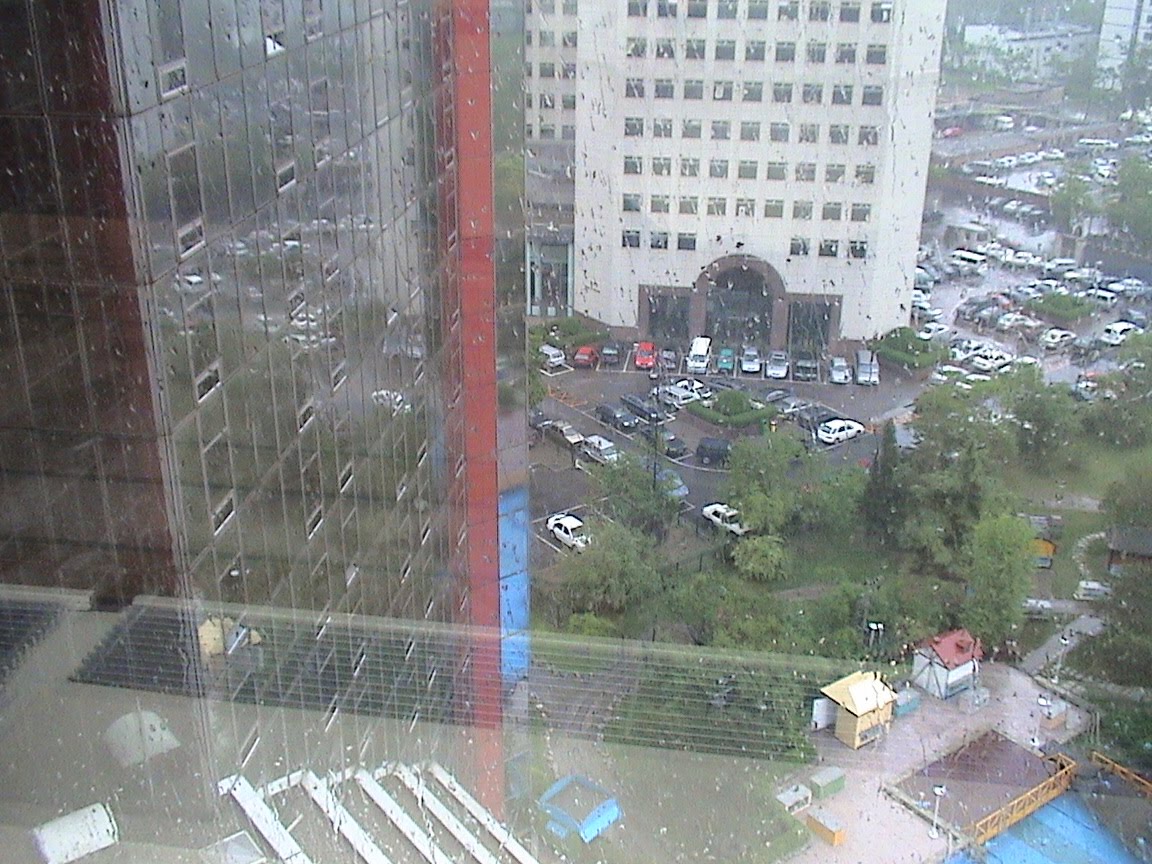
We booked in to our room on the 13th floor with good views through the mist of Beijing. The view from our hotel room looking down to the parking area where our cars will be scrutinised.

I hoped the weather omens were not bad for our tour, as within a couple of hours it had started to pour with rain. Oh, for the sunshine of an English spring! We had a very good meal with Joshua in the hotel bistro.
I met up with Mike Preston, one of the organising team, who told me that all the cars have been unloaded, checked over and engines started. With any luck we won't have the probelms with starting the car that we had in Rio!
In the hotel foyer, there was an artist who painted your name with each letter represented by an animal and Wendy bought one.
After a very smooth and uneventful 10 hour flight we arrived in Beijing at 9.30am. We had Nick Faldo sitting next to us, on his way to the Beijing Open which is being played here in a few days time. Also on the flight were several other participants and, after collecting our bags. We were met at the airport by the girlfriend of Joshua, a young man introduced to us by friends in London. We also met up with Richard Smith and Terence and Mary English and went together in a mini-bus to The Sheraton Great Wall Hotel.
We booked in to our room on the 13th floor with good views through the mist of Beijing. The view from our hotel room looking down to the parking area where our cars will be scrutinised.
I hoped the weather omens were not bad for our tour, as within a couple of hours it had started to pour with rain. Oh, for the sunshine of an English spring! We had a very good meal with Joshua in the hotel bistro.
I met up with Mike Preston, one of the organising team, who told me that all the cars have been unloaded, checked over and engines started. With any luck we won't have the probelms with starting the car that we had in Rio!
In the hotel foyer, there was an artist who painted your name with each letter represented by an animal and Wendy bought one.
April 26th - Beijing
We awoke to pouring rain and virtually no views of Beijing from our room on the 13th floor.
At breakfast we met other participants including Ahmad. Next door to the hotel was the Lufthansa Centre where there was a large supermarket. We stocked up for the start of the drive.
In the afternoon we went with Cris to find a Nokia shop to purchase Chinese SIM cards. We bought the cards for a fraction of the cost back in the UK. A good start to the tour! We took a taxi back to the hotel to get ready for a pre-event briefing in the hotel and then a dinner organised by HERO.
We all went down to the briefing room for the talk by John Brown. It was the usual misture of serious stuff but with a good few laughs thrown in!

Several coaches took us all to a Peking Duck restaurant. It was a pleasant evening, though the food was not as good as our local Chinese restaurant in London!
We learnt that Jim Taylor had arrived minus his Chinese girlfriend. She had been refused entry into China because of a political problem and had been sent back to Hing Kong, from where she would return to the US.
At breakfast we met other participants including Ahmad. Next door to the hotel was the Lufthansa Centre where there was a large supermarket. We stocked up for the start of the drive.
In the afternoon we went with Cris to find a Nokia shop to purchase Chinese SIM cards. We bought the cards for a fraction of the cost back in the UK. A good start to the tour! We took a taxi back to the hotel to get ready for a pre-event briefing in the hotel and then a dinner organised by HERO.
We all went down to the briefing room for the talk by John Brown. It was the usual misture of serious stuff but with a good few laughs thrown in!

Several coaches took us all to a Peking Duck restaurant. It was a pleasant evening, though the food was not as good as our local Chinese restaurant in London!
We learnt that Jim Taylor had arrived minus his Chinese girlfriend. She had been refused entry into China because of a political problem and had been sent back to Hing Kong, from where she would return to the US.
April 27th - Beijing
We got up early to collect the cars. The weather has improved considerably and we went by coach to collect the cars from a local race circuit where they had been stored.
First sight of the car since it left London a few weeks ago.

The Swiss Hummer, Car No.29, belonging to Bernard Legrand.

We drove back to the hotel and had our first taste of Chinese driving. Cars, cyclists, pedestrians were everywhere and roundabouts were particularly hazardous! We got back to the hotel within an hour. It was good to see many of the participants lined up outside the hotel, and we were very pleased to see Patsy and David Mitchell, car 31. They had made a last-minute decision to join the tour and had rented a Chinese Jeep. Later I was alarmed to see Jingers lying underneath the car, already having to do repairs.
Don Griffiths and our Chinese guide and interpreter, Leefeng.

Clay Regazzoni and his Mistubishi Pajero Sport, Car No.15.

The cars lined up in the hotel car park.

In the evening we all went to dinner at The Hot Pot Restaurant located towards the centre of the city. We were presented with tables of raw food and 'liquid' in dishes and had to be shown how to cook it, like a fondue. Some of it was better than others and prawns were thrown in still alive.
The coaches took us back to the hotel and tomorrow is Day 1 of the Grand Tour.
First sight of the car since it left London a few weeks ago.

The Swiss Hummer, Car No.29, belonging to Bernard Legrand.

We drove back to the hotel and had our first taste of Chinese driving. Cars, cyclists, pedestrians were everywhere and roundabouts were particularly hazardous! We got back to the hotel within an hour. It was good to see many of the participants lined up outside the hotel, and we were very pleased to see Patsy and David Mitchell, car 31. They had made a last-minute decision to join the tour and had rented a Chinese Jeep. Later I was alarmed to see Jingers lying underneath the car, already having to do repairs.
Don Griffiths and our Chinese guide and interpreter, Leefeng.

Clay Regazzoni and his Mistubishi Pajero Sport, Car No.15.

The cars lined up in the hotel car park.

In the evening we all went to dinner at The Hot Pot Restaurant located towards the centre of the city. We were presented with tables of raw food and 'liquid' in dishes and had to be shown how to cook it, like a fondue. Some of it was better than others and prawns were thrown in still alive.
The coaches took us back to the hotel and tomorrow is Day 1 of the Grand Tour.
April 28th - Day 1 - Beijing to Wutaishan
We left the hotel at 7am to go the the Great Wall where the official start was taking place.
Greg Williams directing one of the cars out of the car park. Lost already!

We very quickly took a wrong turning coming out of Beijing but found our way back to the route and arrived at the Great Wall just after 8am.


The start ceremony was taking place in a square next to the Wall and there were Chinese dancers performing as we arrived. We parked the car and then walked up a very steep section of the Wall, taking many photos of the impressive scenery. We returned to the car and watched the Chinese dragon dancers accompanied by extremely loud fire-crackers.


Wendy had her first experience of a Chinese public toilet!
We drove out of the square in number order. We were No.18 and were waved away by John Brown with a Chinese flag. There was a lot of hooting and clapping and we drove down the middle of the dancers with one long dragon on either side.


Our drive south was via the Janshi expressway and we laughed when we saw several HERO cars going in the opposite direction!
It was a good drive once we got onto the country roads and our first stop was at the Qing-Tai tombs (17th - 20th century), two hundred miles south-west of Beijing. It was a very interesting and beautiful place.


We climbed up to the the tombs and Wendy then had her second experience of a Chinese toilet, even more disgusting than the first!! The local women don't bother to shut the doors!!
We drove over mountain passes with large drops and through villages where the locals waved as we went by. We were pleasantly surprised that the military and police in toll booths smiled and said bye-bye as we drove away. We stopped in Laiyuan for lunch and the Chinese guide, Ma, helped us order. The charming young waitresses tried out their English. The food was good and the Mitchells joined us and said that they had a noise coming from one of the wheels. A bad omen? Another bad loo experience for Wendy, this time even worse than the two before!!
The day's drive ended 250 miles on from the tombs. It was still light when we arrived at 7pm at our hotel, the Yinhai, Wutaishan.The hotel was a beautiful traditional Chinese building on the outside but nothing special inside.

Dinner was an experience! We sat at large round tables and the waitresses refused to serve us until every seat was taken. We waited ages for our food, which was good, and accompanied by Chinese beer. We had two power cuts during the evening.
When we went to bed at 10.30pm we learnt that the Mitchells had not arrived and Jingers was with them.
Greg Williams directing one of the cars out of the car park. Lost already!

We very quickly took a wrong turning coming out of Beijing but found our way back to the route and arrived at the Great Wall just after 8am.


The start ceremony was taking place in a square next to the Wall and there were Chinese dancers performing as we arrived. We parked the car and then walked up a very steep section of the Wall, taking many photos of the impressive scenery. We returned to the car and watched the Chinese dragon dancers accompanied by extremely loud fire-crackers.


Wendy had her first experience of a Chinese public toilet!
We drove out of the square in number order. We were No.18 and were waved away by John Brown with a Chinese flag. There was a lot of hooting and clapping and we drove down the middle of the dancers with one long dragon on either side.


Our drive south was via the Janshi expressway and we laughed when we saw several HERO cars going in the opposite direction!
It was a good drive once we got onto the country roads and our first stop was at the Qing-Tai tombs (17th - 20th century), two hundred miles south-west of Beijing. It was a very interesting and beautiful place.


We climbed up to the the tombs and Wendy then had her second experience of a Chinese toilet, even more disgusting than the first!! The local women don't bother to shut the doors!!
We drove over mountain passes with large drops and through villages where the locals waved as we went by. We were pleasantly surprised that the military and police in toll booths smiled and said bye-bye as we drove away. We stopped in Laiyuan for lunch and the Chinese guide, Ma, helped us order. The charming young waitresses tried out their English. The food was good and the Mitchells joined us and said that they had a noise coming from one of the wheels. A bad omen? Another bad loo experience for Wendy, this time even worse than the two before!!
The day's drive ended 250 miles on from the tombs. It was still light when we arrived at 7pm at our hotel, the Yinhai, Wutaishan.The hotel was a beautiful traditional Chinese building on the outside but nothing special inside.

Dinner was an experience! We sat at large round tables and the waitresses refused to serve us until every seat was taken. We waited ages for our food, which was good, and accompanied by Chinese beer. We had two power cuts during the evening.
When we went to bed at 10.30pm we learnt that the Mitchells had not arrived and Jingers was with them.
April 29th - Day 2 - Wutaishan to Pingyao
We had a very odd breakfast which was not very nice at all. We left the hotel and drove up to the centre of the town going past several monks taking one step at a time and then lying prostrate on the ground. We learnt later that they take months/years to reach their destination in Tibet.
In the town we visited a temple and pagoda and were the only tourists. The white pagoda behind a brick wall with this circular hole.

We were told by the monks in the temple to kneel and bow down to the ground three times at the sound of a bell. We then had to make a 'donation' and light incense. We were taken inside to look at the Buddhas and then the bowing had to be repeated with more 'donations'!!

We returned to our hotel and then drove along a lovely road out of Wutaishan. The road rose to 6,000 feet and we encountered lots of three wheel tuk-tuks loaded with all sorts of goods. Some were hardly moving due to the colossal loads they were carrying. At one point we saw a flock of sheep above the road on the side of the hill when one of the sheep slipped and fell with a bump to the road. It seemed OK as we drove past.
The winding road to Pingyao.

We stopped at Xinzhou for lunch in a small restaurant. Several other participants were already there and we were joined by Derek McConnell and Alan Crisp (Car No.7).

Here the loo was something to behold. We went through the kitchen and living quarters to a dirty yard full of rubble and flies to a slit in the ground with a low breeze block wall aound it! The flies were very unpleasand and we hoped we wouldn't get bitten!
Chris drove after lunch and we had a few tricky navigation decisions as the road book wasn't always very accurate. A beautiful avenue of trees after our lunch stop.

We arrived in Pingyao at 2.30pm after a drive of 300 kms. Our hotel, the Yung Feng Bin Guan, was two star with very basic rooms and peeling plaster, located on a large roundabout outside the city walls.

We went with Chris in a tuk-tuk to the old town going through one of the city gates. The town is the only remaining walled Han Chinese city built in the Zhou Dynasty (827-728BC) and rebuilt in the Ming period (1370AD). It was a thriving merchant town where the earliest 'Tongs' or banks were set up. Pingyao was the centre of finance for the whole of China in the Qing period.
We visited various museums and temples within the walls and walked along the ramparts overlooking the old city. Here is one of the gates into the walled city and below a street full of small shops and stalls selling all kinds of things.


One of the many old buildings inside the walls of Pingyao.

On top of the walls looking down on Pingyao.

A typical scene wherever we parked the cars, crowds quickly gathered around us.

A group of elderly Chinese men playing cards.

A group photo of happy HERO participants in the streets of Pingyao.

When we returned to the hotel we had another power cut before we went to dinner with the de Hullu family. The food wasn't bad but after being in China for over a week we are now starting to tire of Chinese food!
In the town we visited a temple and pagoda and were the only tourists. The white pagoda behind a brick wall with this circular hole.

We were told by the monks in the temple to kneel and bow down to the ground three times at the sound of a bell. We then had to make a 'donation' and light incense. We were taken inside to look at the Buddhas and then the bowing had to be repeated with more 'donations'!!

We returned to our hotel and then drove along a lovely road out of Wutaishan. The road rose to 6,000 feet and we encountered lots of three wheel tuk-tuks loaded with all sorts of goods. Some were hardly moving due to the colossal loads they were carrying. At one point we saw a flock of sheep above the road on the side of the hill when one of the sheep slipped and fell with a bump to the road. It seemed OK as we drove past.
The winding road to Pingyao.

We stopped at Xinzhou for lunch in a small restaurant. Several other participants were already there and we were joined by Derek McConnell and Alan Crisp (Car No.7).

Here the loo was something to behold. We went through the kitchen and living quarters to a dirty yard full of rubble and flies to a slit in the ground with a low breeze block wall aound it! The flies were very unpleasand and we hoped we wouldn't get bitten!
Chris drove after lunch and we had a few tricky navigation decisions as the road book wasn't always very accurate. A beautiful avenue of trees after our lunch stop.

We arrived in Pingyao at 2.30pm after a drive of 300 kms. Our hotel, the Yung Feng Bin Guan, was two star with very basic rooms and peeling plaster, located on a large roundabout outside the city walls.

We went with Chris in a tuk-tuk to the old town going through one of the city gates. The town is the only remaining walled Han Chinese city built in the Zhou Dynasty (827-728BC) and rebuilt in the Ming period (1370AD). It was a thriving merchant town where the earliest 'Tongs' or banks were set up. Pingyao was the centre of finance for the whole of China in the Qing period.
We visited various museums and temples within the walls and walked along the ramparts overlooking the old city. Here is one of the gates into the walled city and below a street full of small shops and stalls selling all kinds of things.


One of the many old buildings inside the walls of Pingyao.

On top of the walls looking down on Pingyao.

A typical scene wherever we parked the cars, crowds quickly gathered around us.

A group of elderly Chinese men playing cards.

A group photo of happy HERO participants in the streets of Pingyao.

When we returned to the hotel we had another power cut before we went to dinner with the de Hullu family. The food wasn't bad but after being in China for over a week we are now starting to tire of Chinese food!
April 30th - Day 3 - Pingyao to Luoyang
We left at 7.30am and we all were pleased to leave a pretty dire hotel. Today's drive is over 400kms. The weather was grey and gloomy. The drive was fine until we reached huge obstacles on a narrow village road. There were piles of rocks everywhere that might have been the result of landslides or road works.


We came to a halt behind many other Great Tour cars.

We lined up waiting to get through and were finally allowed to pass ahead of the trucks. After a while we reached the next obstacle - an extremely muddy section of road. The mud was at least a foot deep in places and driving through it was virtually impossible. We then came across a truck stuck in the mud blocking the road. The only way through was via a steep track down into the fields alongside the road. It was a very tricky off-road drive. At one point we went by a local farmer who would not let us through. We tried to 'bribe' him, to no avail. In the end one of the group drove past him and the rest followed. The track took us down into a river bed and then we met a local student who spoke good English and showed us the way to get back to the road. All in all, quite an experience!
Many cars got stuck in the mud and our detour added about ninety minutes to our journey. Apparently the Mitchells, who are now down to two-wheel drive, had to be towed through the mud by Simon Dedman.
We reached Gaoping for lunch, where some of the group had already arrived. Many cars were still stuck in the mud. We had a quick lunch and then Chris did the driving and Wendy navigated. We crossed the Yellow River and went through a very steep gorge with lots of sheer drops. There were many coal lorries carrying ridiculous loads. There was one parking spot for trucks that had hoses positioned to spray water on the over-heated brakes to cool them down!!
One of the coal trucks parked up at the side of the road, in the middle of the gorge, cooling down its brakes.

We arrived in Luoyang in the evening rush hour. It is a huge modern city of eight million people, a total contrast to Pingyao. We had problems, like many others, with the road book instructions to find the hotel., the four star Luoyang Grand. We were on the 14th floor overlooking the car park and our car.


We ate in the hotel and tried to order a western meal with limited success, even with Leefeng's help.


We came to a halt behind many other Great Tour cars.

We lined up waiting to get through and were finally allowed to pass ahead of the trucks. After a while we reached the next obstacle - an extremely muddy section of road. The mud was at least a foot deep in places and driving through it was virtually impossible. We then came across a truck stuck in the mud blocking the road. The only way through was via a steep track down into the fields alongside the road. It was a very tricky off-road drive. At one point we went by a local farmer who would not let us through. We tried to 'bribe' him, to no avail. In the end one of the group drove past him and the rest followed. The track took us down into a river bed and then we met a local student who spoke good English and showed us the way to get back to the road. All in all, quite an experience!
Many cars got stuck in the mud and our detour added about ninety minutes to our journey. Apparently the Mitchells, who are now down to two-wheel drive, had to be towed through the mud by Simon Dedman.
We reached Gaoping for lunch, where some of the group had already arrived. Many cars were still stuck in the mud. We had a quick lunch and then Chris did the driving and Wendy navigated. We crossed the Yellow River and went through a very steep gorge with lots of sheer drops. There were many coal lorries carrying ridiculous loads. There was one parking spot for trucks that had hoses positioned to spray water on the over-heated brakes to cool them down!!
One of the coal trucks parked up at the side of the road, in the middle of the gorge, cooling down its brakes.

We arrived in Luoyang in the evening rush hour. It is a huge modern city of eight million people, a total contrast to Pingyao. We had problems, like many others, with the road book instructions to find the hotel., the four star Luoyang Grand. We were on the 14th floor overlooking the car park and our car.


We ate in the hotel and tried to order a western meal with limited success, even with Leefeng's help.
May 1st - Day 4 - Luoyang to Xi'an
We left the hotel and drove a short distance to the Longmen Caves, that consist of 2,345 caves and niches with over 100,000 Buddha statutes.
It is a beautiful place by the river Yihe with a temple and other important sites on the opposite bank.We parked up and paid the entrance fee. We walked along the river looking at many of the caves with thousands of carved Buddhas in every conceivable nook and cranny. There were crowds of Chinese visiting the caves as it was the May Day holiday.


Another happy group photo, this time at the Longmen Caves.

We left the caves after an hour or so and within a short time we came up behind a long line of HERO cars parked by the side of the road. We were waved down by the police and told we could not go on as we did not have the correct permit to drive on this particular road in Henan Province.

Many of the group were pretty angry and Jim Taylor ignored the police and drove straight through! We spoke with the police and they appeared quite pleasant but would not relent.We waited about an hour and a half until Jingers and Ma arrived who then managed to get the police to allow us to continue.
We were in a very rural area of China with many houses made of mud and straw. In one area we came across beekeepers, who lived in tents, surrounded by beehives.They looked as though they came from Mongolia rather than China. We drove through many villages where tobacco leaves had been strewn across the road for threshing. It was expected that drivers would help the process by driving over the tobacco.
We stopped for fuel and were joined by Richard Smith in Car No.30.

The road went along the Yellow River which was so wide that it looked like the sea and the last stretch of road was along a fast expressway. When we reached the toll there was a big traffic jam and as we waited thousands of bees swarmed around some trucks that were laden with beehives. It was quite a sight.
We arrived in Xi'an at about 6pm, having driven 430 kms. Our five star hotel was the Shangri-La Golden Flower and our room was on the 6th floor.
The hotel was the best of the tour so far and Wendy would have been happy to stay two weeks instead of two days!! We had a great evening meal prepared by Rolf the hotel's German chef.
It is a beautiful place by the river Yihe with a temple and other important sites on the opposite bank.We parked up and paid the entrance fee. We walked along the river looking at many of the caves with thousands of carved Buddhas in every conceivable nook and cranny. There were crowds of Chinese visiting the caves as it was the May Day holiday.


Another happy group photo, this time at the Longmen Caves.

We left the caves after an hour or so and within a short time we came up behind a long line of HERO cars parked by the side of the road. We were waved down by the police and told we could not go on as we did not have the correct permit to drive on this particular road in Henan Province.

Many of the group were pretty angry and Jim Taylor ignored the police and drove straight through! We spoke with the police and they appeared quite pleasant but would not relent.We waited about an hour and a half until Jingers and Ma arrived who then managed to get the police to allow us to continue.
We were in a very rural area of China with many houses made of mud and straw. In one area we came across beekeepers, who lived in tents, surrounded by beehives.They looked as though they came from Mongolia rather than China. We drove through many villages where tobacco leaves had been strewn across the road for threshing. It was expected that drivers would help the process by driving over the tobacco.
We stopped for fuel and were joined by Richard Smith in Car No.30.

The road went along the Yellow River which was so wide that it looked like the sea and the last stretch of road was along a fast expressway. When we reached the toll there was a big traffic jam and as we waited thousands of bees swarmed around some trucks that were laden with beehives. It was quite a sight.
We arrived in Xi'an at about 6pm, having driven 430 kms. Our five star hotel was the Shangri-La Golden Flower and our room was on the 6th floor.

The hotel was the best of the tour so far and Wendy would have been happy to stay two weeks instead of two days!! We had a great evening meal prepared by Rolf the hotel's German chef.
Subscribe to:
Posts (Atom)